“The burden of fatal police violence is an urgent public health crisis in the USA. Mounting evidence shows that deaths at the hands of the police disproportionately impact people of certain races and ethnicities, pointing to systemic racism in policing…{in this study} We evaluated the extent of under-reporting of deaths due to police violence in the USA at the state level by race and ethnicity by comparing vital registration data to three non-governmental, open-source databases: Fatal Encounters, Mapping Police Violence, and The Counted.” — The GBD 2019 Police Violence US Subnational Collaborators, Fatal police violence by race and state in the USA, 1980–2019: a network meta-regression (2021)
The authors of the above study define police violence as “police-related altercations leading to death or bodily harm”. Of the three non-governmental databases they use to estimate the true extent of police violence in the USA, Fatal Encounters (FE) is by far the biggest. Here is more on the FE data, provided by the authors in their Supplementary Material:
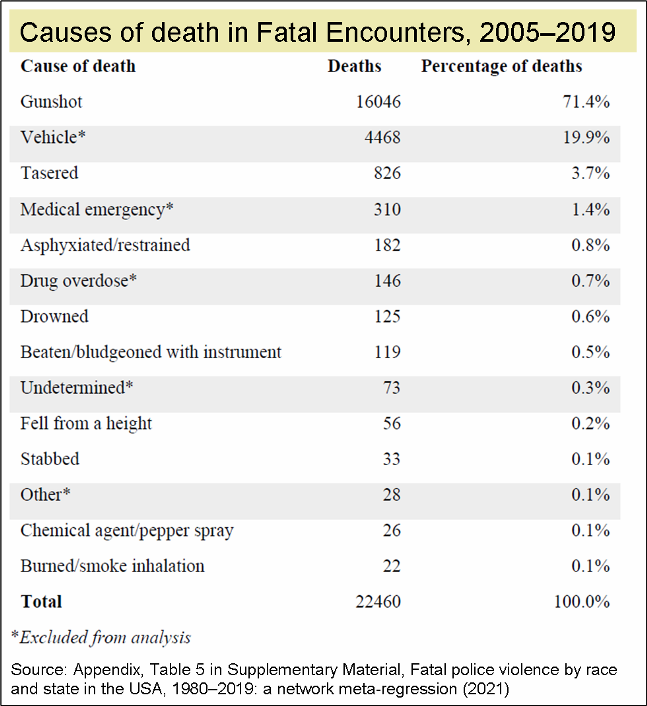
Fatal Encounters provides extensive information on each death, including circumstances of death and links to the original sources (often news stories). All of this information is on spreadsheets available to the public. Out of curiosity I decided to look more closely at the deaths by gunshot, since they are by far the largest category of deaths. This is what I found in the first 50 spreadsheet entries:
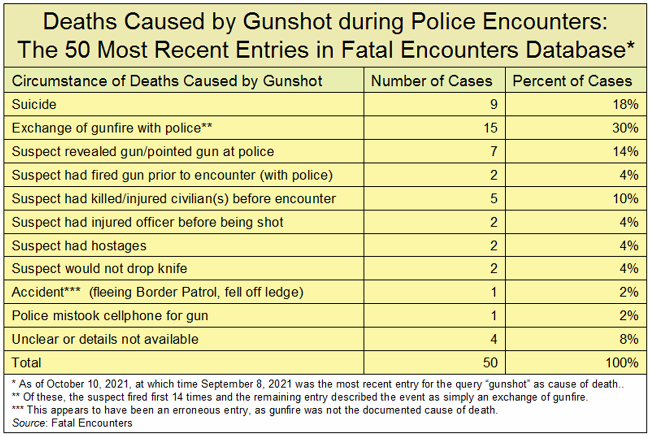
The above breakdown of circumstances was mine, based on descriptions of the events that preceded suspects’ deaths. However, FE spreadsheets have a column for whether the deaths were the result of an intentional use of force, which reveals some very interesting information on the circumstances of these deaths. Take a look:
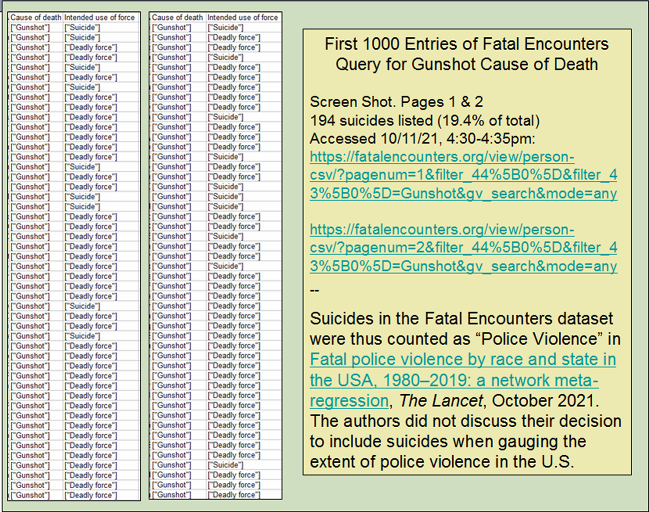
Unfortunately due to print legibility issues, the screen shot doesn’t include the entire 1000 cases. However, Excel counted 194 suicides in the 1000-case sample. That would be 19.4% of the total. I included the FE links below for anyone to check for themselves. I later did a query for suicide in the entire FE dataset, which revealed that, as of October 12, 2021, 15% of the Fatal Encounters with police were suicides. Almost all the suicides were deaths by gunshot, which were 92% of all deaths FE deaths considered by the authors of Fatal Police Violence. In other words, suicides were close to a tenth of the dataset used by the authors to document the extent of police violence. .
Should suicides really be counted as police violence? Or, for that matter, cases where the suspect fired the first shot…or had killed hostages? This matters, because the authors of this study, and others, are using these phony calculations of police violence to push for specific policies that may end up doing more harm than good.
Updated October 12, 2021
—
Next: What policies are the authors of Fatal Police Violence recommending and what evidence do they cite that other policies are not working to stem deaths that occur during encounters with police?
Links and Reference:
Fatal police violence by race and state in the USA, 1980–2019: a network meta-regression, authored by the GBD 2019 Police Violence US Subnational Collaborators. The Lancet, Volume 398, Issue 10307, 2–8 October 2021, Pages 1239-1255 https://doi.org/10.1016/S0140-6736(21)01609-3