Recap
Between a Covid-battered economy and trillions in stimulus spending, it will take years to shrink the federal debt back to a manageable size. In the meantime, the Bold Centrist still wants to fix this country, focusing on six problem areas: healthcare, infrastructure, poverty, social mobility, housing, and threats to the biosphere. The challenge is how to fund the repair job without adding to the public debt or zapping economic growth.
Short answer: increase tax revenue, which has hovered around 25% of GDP for decades. Let’s increase that to 36.3% of GDP, which is a bit more than what Canada collects (33.8% of GDP) but less than Germany (38.8% of GDP). This would generate an extra $2.6 trillion a year in tax revenues (based on 2020 GDP and ignoring GDP growth and inflation for now).
So far I’ve spent $578 billion a year to achieve universal healthcare, reduce poverty, increase social mobility, and combat climate change (a threat to the biosphere). For details, see Childcare Subsidies, Part II: A Specific Proposal, The Bold Centrist: How Much Would It Cost to Decarbonize the US Economy by 2050?, The Bold Centrist: A Responsible Budget for Fixing This Country, The Bold Centrist, Part VII: How to Pay for Universal Health Care on a Budget, The Bold Centrist: Why an Adult Student Basic Income is Better than Pell Grants (and What the Danes Have); The Bold Centrist: Here's How the US could fund an Adult Student Basic Income on Less than $2 a Day per Capita in New Taxes; and, The Beauty of an Adult Student Basic Income.
There’s still a lot to accomplish. This time around I’m going to address what more the US Department of Agriculture (USDA) can do to protect the environment, increase biodiversity, and combat climate change.
The USDA already has several programs that help agricultural producers and foresters adopt and maintain conservation systems that protect water and air quality, reduce soil erosion, protect and enhance wildlife habitat, forests and wetlands, conserve water, and sequester carbon. Here are some of them:
Natural Resources and Environment programs: help reduce wildland fire risk, improve forest and grassland conditions, promote recreation opportunities on National Forest Service lands, and generate economic benefits for rural communities.
Research, Education and Economics programs: support research to advance the competitiveness of U.S. agriculture and promote food security. Also provides funds for new initiatives on precision agriculture research, long-term agroecosystems research, artificial intelligence innovations for agriculture production, and research on managing excess water and controlling erosion.
Agricultural Pest and Disease Programs: help protect agriculture from pests and diseases, addresses animal and plant trade concerns, and enforces animal care legislation.
Water Bank Program (no new funding since 2019): helped preserve and improve major wetlands as habitat for migratory waterfowl and other wildlife. Landowners signed multi-year rental agreements to protect wetlands and provide wildlife habitat and in return received annual payments for conserving and protecting wetlands and adjacent lands from adverse land uses and activities, such as drainage, that would destroy the wetland characteristics of those lands.
Wetlands Mitigation Banking Program: provides competitive grants that support the development and establishment of wetland mitigation banks to make credits available for agricultural producers. Wetland mitigation banking is the restoration, creation or enhancement of wetlands for the purpose of compensating for unavoidable impacts to wetlands at another location.
Soil and Water Supply Surveys and Forecasting: aids the assessment of watershed health by providing static and dynamic soil properties that affect water quality, as well as snow survey and water supply forecasts that can be used to improve water supply forecasts and provide real-time climate and snowpack information in basins that provide water in the western United States.
Environmental Quality Incentives Program: provides financial and technical assistance to farmers and non-industrial forest managers to address natural resource concerns and deliver environmental benefits such as improved water and air quality, conserved ground and surface water, increased soil health and reduced soil erosion and sedimentation, improved or created wildlife habitat, and mitigation against drought and increasing weather volatility.
Conservation Stewardship Program: helps farmers maintain and improve their existing conservation systems and adopt additional conservation activities. For example, CSP can look at ways to address the amount of soil lost; mitigate the impact of excess water; reduce the contribution of agricultural operations to airborne soil particles and greenhouse gas emissions; improve the cover, food, and water available for domestic and wildlife species; and promote energy efficiencies for on-farm activities.
Agricultural Management Assistance: helps farmers manage financial risk through diversification, marketing or natural resource conservation practices. For example, the AMA could help corn farmers diversity to less-resource intensive crops as biofuel subsidies are reduced.
Conservation Reserve Program: assists farmers in conserving and improving soil, water, air, and wildlife resources by converting highly erodible and other environmentally sensitive acreage normally devoted to the production of agricultural commodities to a long-term resource-conserving cover.
Agricultural Conservation Easement Program: helps landowners, land trusts, and other entities protect, restore, and enhance wetlands, grasslands, and working farms and ranches through conservation easements.
Healthy Forests Reserve Program: helps landowners restore, enhance and protect forestland resources on private and tribal lands through easements and financial assistance. Through HRFP, landowners promote the recovery of endangered or threatened species, improve plant and animal biodiversity and enhance carbon sequestration.
Regional Conservation Partnership Program: promotes coordination of conservation activities with partners that help expand our collective ability to address on-farm, watershed, and regional natural resource concerns. Eligible partners include (but are not limited to): farmer cooperatives, state or local governments, water districts, conservation groups (NGOs) and universities.
These are great programs but they are underfunded. Given the immensity of the environmental challenges facing this nation and the world, we need to do a lot more to address the loss of wild habitat, declining biodiversity, mass extinctions, and climate change. This is what I propose, at least in the near term:
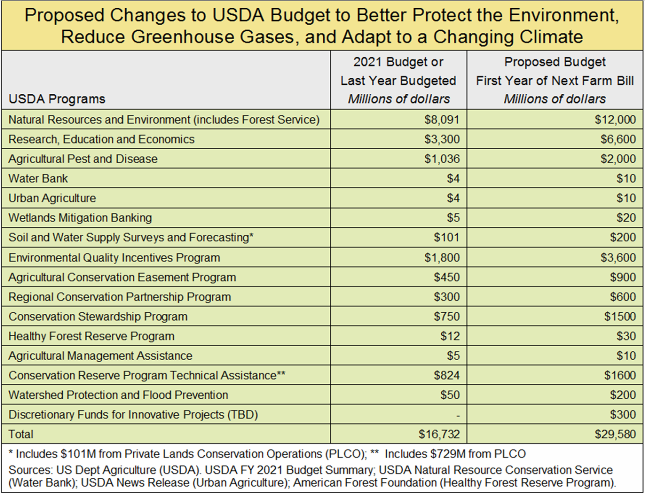
This proposed budget would add almost $13 billion a year to federal spending. That leaves about $2 trillion a year to continue working on poverty, social mobility, housing, infrastructure, and threats to the biosphere.
Links::
USDA Natural Resource Conservation Service
USDA News Release: USDA Announces Grants for Urban Agriculture and Innovative Production