From the Archive (somewhat revised)…
One Way to Detect Signs of Groupthink in Political Circles (August 2022)
“Groupthink being a coinage – and, admittedly, a loaded one – a working definition is in order. We are not talking about mere instinctive conformity – it is, after all, a perennial failing of mankind. What we are talking about is a rationalized conformity – an open, articulate philosophy which holds that group values are not only expedient but right and good as well.” - Whyte, W. H., Jr.
“Groupthink is a group conformity bias where pressure from oneself, peers, or leaders to produce consensus may limit discussion because potential dissenters self-censor, change or suppress a contrary opinion or evidence despite actual underlying disagreement.” - Kaitlyn McLeod and Edward Feller
“Groupthink requires individuals to avoid raising controversial issues or alternative solutions, and there is loss of individual creativity, uniqueness and independent thinking. The dysfunctional group dynamics of the "ingroup" produces an "illusion of invulnerability" (an inflated certainty that the right decision has been made)…Group interactions tend to favor clear and harmonious agreements and it can be a cause for concern when little to no new innovations or arguments for better policies, outcomes and structures are called to question.” Wikipedia
Pew Research interviewed thousands of Americans in 2021 and assigned each to a political group based on their responses to questions about social and political values. So how can one tell if the individuals in any of these groups are subject to groupthink? One way is to look at the level of consensus within a political group - especially on policy-related questions.
One shouldn’t expect a high level of consensus on policy questions even among members of a group that shares social and political values, because different policy prescriptions can serve the same values or policy goals. Also, policy-making is hard and requires consideration of “competing goods and lesser evils, tradeoffs and compromises” (as Kevin Williamson recently put it) One would think if people truly cared about achieving a valued social good - say, the elimination of poverty - they would also sweat over the details as to how to achieve this social good without jeopardizing other social goods. Which means they and their shared-values fellows would be having robust and thoughtful arguments on policy, no consensus expected.
How much agreement constitutes a consensus”? I’m going with 80% for the Pew survey responses, because there are normally 3-6 response options (including “refused to answer”), which means the next-highest response would get less than 20% endorsement in most cases. Close enough to check out the survey responses for signs of groupthink, as measured by within-group agreement of 80% or higher on policy-related survey questions. This is what I found:
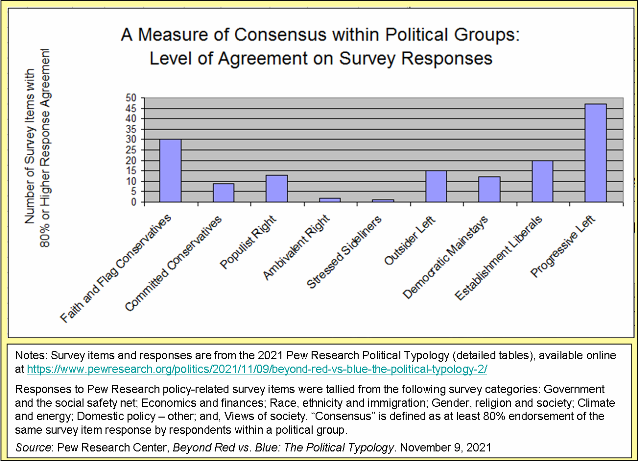
Mmmm. I see a healthy lack of consensus within most of the political groups, except for the Progressive Left, which has 80%+ response agreement on 47 out of 132 survey questions, i.e., on 36% of all items. Flag and Faith Conservatives came in second, with consensus on 23% of survey items. Interestingly, the Populist Right achieved consensus on just 10% of the survey items. In other words, the Populist Right doesn’t appear to have a broad policy agenda. Then again, neither do Committed Conservatives nor Democratic Mainstays.
Overall, the responses of the Progressive Left were much less mixed than those of the other groups. Even if Progressive Left responses didn’t reach consensus level, there was usually a single response that received at least 60% endorsement. Put another way, the Progressive Left failed to reach 60% agreement on responses on just 35 of 132 survey questions – much less than any other group. Check it out:
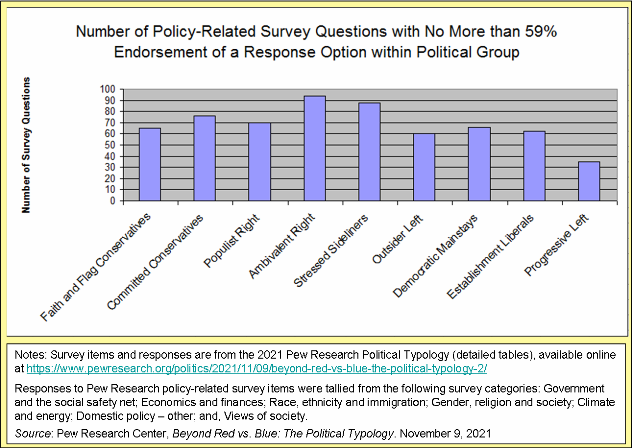
Judging by their responses to the Pew Political Typology survey questions, the Progressive Left appears to follow a single script. To me, that’s a sign of groupthink.
—
Note: Of course, it’s all more complicated than presented here. For one thing, progressives are the most ideological of the political groups and ideologies tend to be quite clear on right and wrong approaches to policy. I would think that ideological groups are also prone to groupthink, given their emphasis on unity, discipline and mission.
References:
“Groupthink, Wikipedia. Accessed August 8, 2022.
McLeod K, Feller E. Groupthink: What's So Great About Teamwork? R I Med J (2013). 2019 Sep 3;102(7):8-9. PMID: 31480809. http://www.rimed.org/rimedicaljournal/2019/09/2019-09-08-commentaries.pdf
Pew Research Center, Beyond Red vs. Blue: The Political Typology. November 9, 2021
Whyte, W. H., Jr. (March 1952). "Groupthink". Fortune. pp. 114–117, 142, 146.