Note: I just got back from a vacation. While I catch up with my reading and gather my thoughts for new posts, here’s something from the archive, slightly revised and followed by an update.
—
How to Spot Misleading Science Writing / Exploring the Problem Space July 23, 2024
From Beware persuasive communication devices when writing and reading scientific articles (Corneille et al, 2023):
“Authors rely on a range of devices and techniques to attract and maintain the interest of readers, and to convince them of the merits of the author’s point of view. However, when writing a scientific article, authors must use these ‘persuasive communication devices’ carefully. In particular, they must be explicit about the limitations of their work, avoid obfuscation, and resist the temptation to oversell their results.”
Does that mean science writers should avoid expressing opinions regarding the significance of whatever they’re writing about? No, but they should do so in the spirit of science: with an abundance of caution and plenty of hedging. Above all, they need to take care not to mislead or exaggerate.
Per Corneille et al, problematic persuasive devices in science writing include:
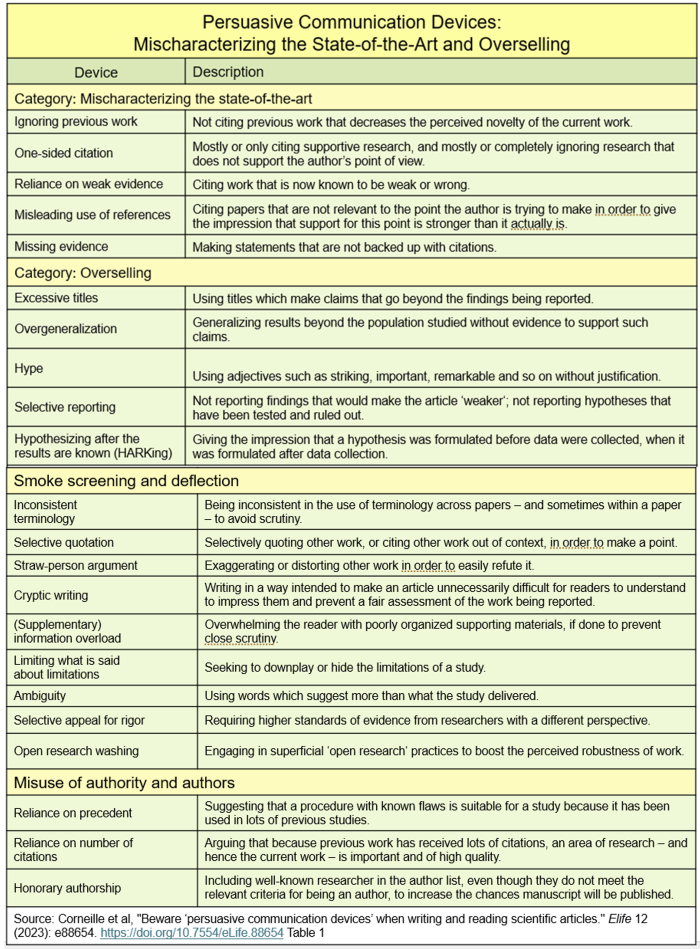
Corneille et al did stress that the above typology was still a work-in-progress and should not be approached dogmatically as iron-clad rules.
December 2025 Update:
Per Google Scholar, Corneille et al has received 28 citations as of December 30, 2025. The following excerpts are from one of the citing articles, The Next Chapter for Psychological Science, by editor-in-chief Simine Vazire:
Striking the right balance requires a great deal of trust in the editors of [selective journals]. The author who admits the limitations of their work and carefully incorporates those limitations into their conclusions (e.g., including qualifiers in their abstract or title) is taking the risk that editors will be more attracted to the submissions with bold claims and fewer caveats.
We cannot ask authors to embrace intellectual humility and calibration unless the editors are prepared to follow through—to prefer manuscripts with well-calibrated claims to those that overclaim.…unwarranted bold claims will harm chances of acceptance, and exaggeration will be considered a potential basis for desk rejection. We are looking for excellent research, but we expect even the best research to have flaws, and we want those flaws to be factored into the whole manuscript, including the conclusions drawn.
Importantly, science benefits when authors share their opinions, speculations, and extrapolations about what their results might mean, and readers want to know these things. Similarly, authors should not shy away from explicitly stating their assumptions and their justification for those assumptions. However, speculations, assumptions, and other claims that go beyond the evidence should be clearly flagged as such wherever they appear (including in abstracts).
Finally, we are also continuing to find ways to keep hype in check in public-facing reports about Psychological Science articles. We are working with the APS Scientific and Public Affairs office to have editorial input into press releases and other media reports of our articles. In addition, authors will no longer be asked to submit a statement of relevance—if we reintroduce something like a public abstract, those will be written by members of the editorial team in collaboration with authors.
The open-science movement has made great strides in increasing the transparent reporting of research, making scientific claims easier to evaluate and making research more accountable…We are making several changes to increase the transparency and accountability of our journal operations.
We will strive to make as much information public as possible about our [submitted article] evaluation criteria.
We will also offer “Registered Report with Existing Data”, [which will] help reduce the opportunity for bias stemming from authors’ decisions during data collection and analysis…
We will continue to enforce conflict-of-interest rules—no editor or reviewer will be involved in the peer review of a manuscript where they have a conflict of interest with an author…
We can also make ourselves more accountable by giving readers access to more information about the peer review that went into vetting our published articles.
We are encouraging replication submissions by …allowing replication work to be submitted like any other empirical work.
These are welcome developments. I hope other science journals are adopting similar standards.
—
* Some changes to punctuation and capitalization were made to increase readability.
Related Posts: When Cause Trumps Truth: The Case of Agenda-Driven Science Behind the Headlines: Scientists Mistrust a Lot of Published Research Science, Humility and the Qualities of Good Research Writing
References
Corneille, Olivier, Jo Havemann, Emma L. Henderson, Hans IJzerman, Ian Hussey, Jean-Jacques Orban de Xivry, Lee Jussim et al. "Beware ‘persuasive communication devices’ when writing and reading scientific articles." Elife 12 (2023): e88654 https://doi.org/10.7554/eLife.88654
Vazire, S. (2023). The Next Chapter for Psychological Science. Psychological Science, 35(7), 703-707. https://doi.org/10.1177/09567976231221558