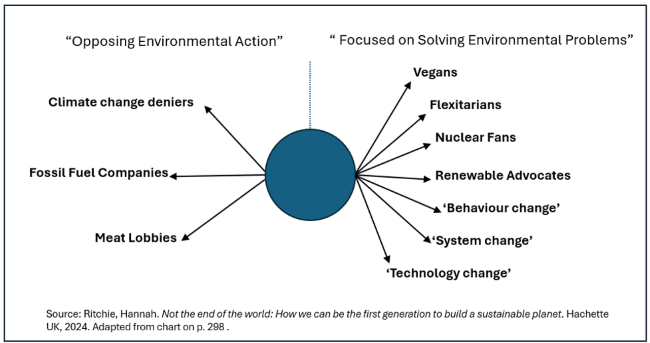
In her mostly terrific book, Not the End of the World, Hannah Ritchie argues that to solve environmental problems, we need to work with those who want to solve the same problems but have different ideas on the best way to move forward. Otherwise, we become too distracted by internal fighting to put up serious resistance to the “real opponents of progress”, such as climate change deniers, fossil fuel companies, and meat lobbies. Here’s the idea*, adapted from a chart in Ritchie’s book (p. 298):
As noted in my last post, it is quite possible to doubt climate change and still care about protecting nature. For example, a few years back Pew Research conducted in-depth interviews with climate change skeptics and noted in their report a “common call across interviews…for actions to protect natural lands and waterways.” So why shouldn’t environmentalists embrace skeptics as occasional allies in areas where they share a common interest - say, saving endangered species or protecting wild habitat?
The same goes for fossil fuel companies and the meat industry. Yes, these are businesses whose main interest is profit and survival. I don’t expect them to willingly self-destruct. That doesn’t mean they can’t be allies on some environmental issues, eg, reducing methane emissions. But I don’t require that they really care about these issues. Environmental allies don’t need to be pure of motive as long as they contribute to a worthy cause. Maybe they’re just chasing positive PR - and that’s ok.
By way of illustration, the Environmental Defense Fund, World Wildlife Fund and Nature Conservancy have all worked with large meat and dairy companies, ranchers, and trade groups on a range of initiatives. And the Oil and Gas Climate Initiative (OGCI) is a CEO-led group focused on leading the energy industry’s “response to climate change and accelerating action to a net zero future”. Are the OGCI member companies motivated mostly by self-interest? Probably. Does it matter? No.
—
* Briefly: vegans don’t eat animal products; flexitarians are mostly vegetarian but occasionally eat meat and fish; nuclear fans consider nuclear energy an essential component of reaching net-zero emissions; behaviour change focuses on adopting more sustainable behaviours to reduce emissions and negative environmental impacts, eg, recycling, driving electric vehicles; system change focuses on broader societal, cultural and economic changes, such as carbon pricing, dense housing, public transportation, post-capitalist communitarianism; technology change focuses on technological solutions to reduce emissions, such as carbon capture and gene-editing crops for drought resistance.
Reference:
Ritchie, Hannah. Not the end of the world: How we can be the first generation to build a sustainable planet. Hachette UK, 2024