The U.S. spends over twice as much per capita on healthcare as the OECD average*. Unfortunately, our healthcare spending keeps growing faster than inflation and is projected to reach $24,000 per capita by 2033 - roughly 20% of GDP. Between the ever-expanding national debt and a graying population, this is an untenable situation.
The U.S. needs to come up with a less costly healthcare system that performs well and serves all Americans. A better healthcare system would include:
1. Universal coverage
2. Continuity with existing system
3. Mandatory participation
4. Clinically necessary care
5. Benchmark pricing incentives
6. Competitive market
7. Consumer choice
8. Lower administrative burden
9. Hardship subsidies
I will address universal coverage in this post. First, a definition:
“Universal health coverage means that all people have access to the full range of quality health services they need, when and where they need them, without financial hardship. It covers the full continuum of essential health services, from health promotion to prevention, treatment, rehabilitation and palliative care.” World Health Organization. Universal Health Coverage
Actually, that’s a rotten definition, nice words but not practical. “When and where they need” services? No country offers that - not even the most developed. Take a look:
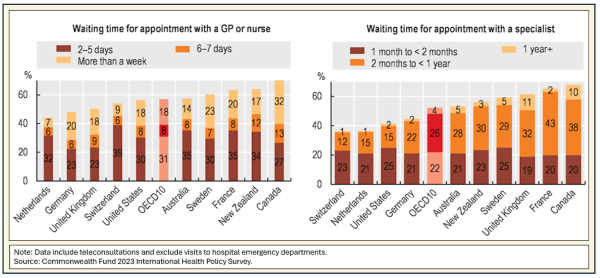
Long wait times for specialist care is the rule in developed countries. It’s likely that many people in these countries who need faster specialist care do not get it. For example, my mother suffered a compound leg fracture in the U.K. and had to wait three weeks for it to be set. Yeah, she survived the ordeal, but I would hope that medical need encompasses more than “will die unless get treatment asap”.
As for access to services where people need them: no large country can guarantee specialist care within a reasonable commuting distance. Getting primary care to rural areas is hard enough.
The WHO definition of universal health coverage further stipulates that access to care be “without financial hardship”. If we define “hardship” as severe deprivation or suffering, that’s a reasonable goal. But people do bear the costs of their healthcare systems one way or another, whether through taxes, insurance premiums or out-of-pocket expenses. And these costs can sting - sometimes so much that those on a tight budget might put off care. Despite the sting and impact on care utilization, out-of-pocket expenses, such as co-pays and deductibles, are commonplace in developed countries, including those with universal care. Check it out:
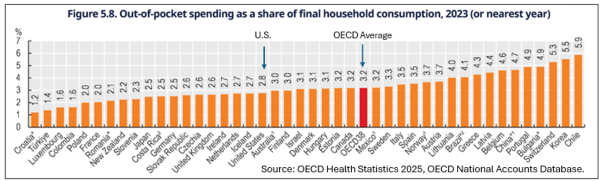
Out-of-pocket costs in healthcare plans and system are sometimes used as a way to discourage overuse of provider resources for nonurgent or minor issues. This type of demand management reduces rationing of necessary care and shortens wait times for those with more serious medical problems. Out-of-Pocket payments are also an important source of funding for healthcare systems. Across OECD countries, just under one‑fifth of all spending on healthcare comes directly from patients through these payments, on average.
Given the above reservations about WHO’s definition of universal healthcare coverage, I will amend it as follows: Universal health coverage means that all residents of a country have access to evidence-based medically necessary health services without incurring financial hardship. It covers the full continuum of services, from health promotion to prevention, treatment, rehabilitation and palliative care. As for what constitutes medically necessary services:
From your doctor or nurse practitioner's perspective, medical necessity refers to any health service or product they prescribe for you that will prevent, diagnose or treat a condition …Some elements of medical necessity include:
Services that are necessary for the treatment, cure, or relief of an illness, injury, or disease.
Services explicitly provided for the diagnosis, treatment, cure, or relief of an illness, injury, or disease that are NOT for investigational, experimental, or cosmetic purposes.
Services that are appropriate in terms of frequency, duration, and location and also considered effective.
— What Is A Medical Necessity and How Is It Determined? United States of Healthcare
Should the U.S. have a universal healthcare system? By all means! No American should be denied necessary care. Besides, according to the latest Pew survey, 66% of Americans want a universal system, the younger the stronger the support. Even Republicans are getting on the universal healthcare bandwagon - 41% in the latest poll, up from 32% in 2021 (Pew Research, 2025). The time has come to get serious about what such a system should look like in the U.S.
Which is what this series is about.
—
Next: Continuity with existing system
* OECD: Organisation for Economic Co-operation and Development, a club of mostly rich countries.
References:
Financial Hardship and Out-of-Pocket Expenditures / OECD 2025
International Health Policy Survey / Commonwealth Fund 2023
Most Americans say government has a responsibility to ensure health care coverage. By Andrew Daniller Pew Research December 2025.
What Is A Medical Necessity and How Is It Determined? United States of Healthcare December 10, 2025