I recently participated in a debate on California’s Proposition 40, which calls for a one-time 5% wealth tax on the state’s billionaires. Prop 40 advocates repeatedly justified the wealth tax by claiming U.S. billionaires currently pay less in taxes than ordinary Americans, and it’s only fair that they contribute more to the general welfare. Several referred to a study claiming that billionaires pay just 25% of their income in taxes, compared to 30% for the average taxpayer. Clearly not fair - but is it accurate?
Not according to Scott Hodges of The Tax Foundation. Here’s a chart and table based on figures in his 2024 piece The Super-Rich Pay Super-Amounts of Taxes, New Treasury Report Finds:
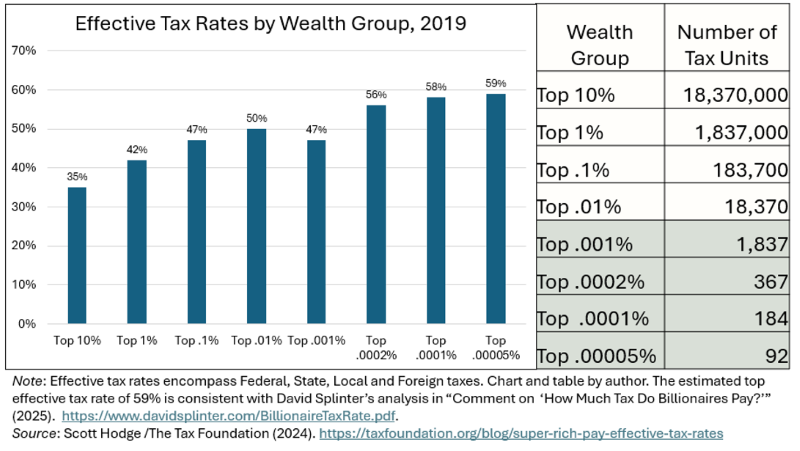
Source of information in Hodges 2024:: Table 1. “Wealth and Income by Wealth Categories, Chart Effective Tax Rates by Wealth Group”, which includes effective rates for Federal (individual income and FICA), State, Local, & Foreign taxes, Chart “Taxes on the Global Business Income of Billionaires Can Raise Their Total Effective Tax Rate to Nearly 60%” and section “But What About the Super-Rich?”
Regarding foreign taxes, Hodge writes:
“At every level of wealth, the Treasury study estimates that tax units bear some amount of foreign corporate income taxes. For the average tax unit, foreign corporate income taxes add less than 1 percentage point to their effective tax rate. But for the wealthy in the top 10 percent, foreign corporate income taxes add 2 percentage points to their effective tax rates, for a total rate of 35 percent. However, for those in the top 0.01 percent, corporate income taxes boost their overall effective tax rate to 50 percent, i.e., half of their annual income…The substantial global interests of the super-rich require them to pay individual income taxes as well as the corporate income taxes they owe to foreign tax authorities. The combined impact of multiple layers of taxes owed to multiple levels of government raises their effective tax rates to exceptionally high levels.”
So what is it - 25% or 59%? I’m leaning in the direction of Hodge, mainly because economist David Splinter arrived at roughly the same figure in his Comment on ‘How Much Tax Do Billionaires Pay?’ (2025). Splinter is a senior economist at the nonpartisan Joint Committee on Taxation, U.S. Congress. He makes his living providing legislators with estimates on the revenue effects of various proposed changes in tax policy. According to his CV, Splinter has analyzed thousands of tax proposals since he began work at the Joint Committee in 2012. Pretty credible, in other words.
The notion that the effective tax rate of U.S. billionaires is just 25% comes from How Much Tax Do Billionaires Pay? (Balkir, Saez, Yagan, and Zucman (2024; updated 2025). In his Comment on this paper, Splinter points out errors in the authors’ analysis, corrects their tax estimates, and arrives at a much higher the effective tax rate: 59%. However, he suggests the top rate could even be higher, stating that “end-of-life giving suggests long-run top 400 effective tax-and-giving rates could exceed 70%”.