…doctors profit by restricting access to medical care. Specifically, they maintain their market power most effectively via artificial constraints.. on the ability of non-physicians to treat patients.
For example, nurse practitioners (NPs) face various restrictions across states, with only twenty-six states and Washington D.C. granting NPs “full practice authority” to diagnose and treat patients without physician supervision. Physician assistants (PAs) face even stricter limitations…
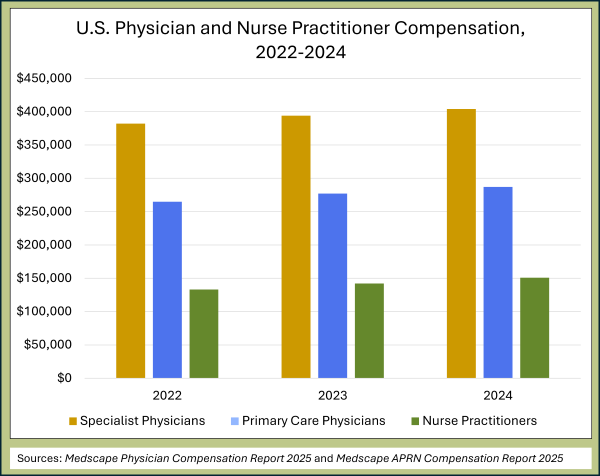
Care costs substantially less when NPs or PAs provide it rather than physicians, studies indicate, and delivers the same health outcomes.
- Owen Zidar and Eric Zwick, The Everywhere Millionaire: Who is Really Rich in America and How They Got There (2026)
You know where NPs and PAs would really come in handy? As primary care providers, because the U.S. has too few of them:
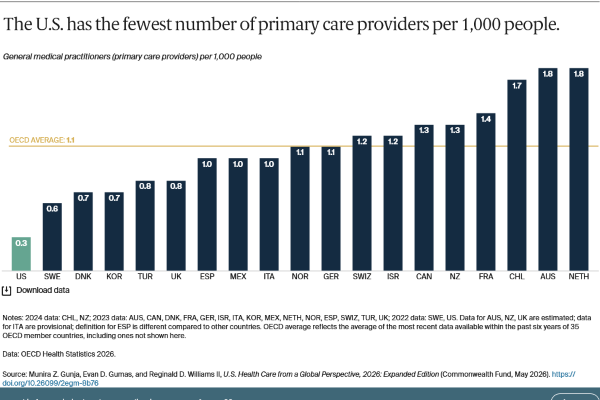
And more primary care providers would go a long way to fixing healthcare shortages, especially when they’re NPs or PAs working in “direct primary care”. The Economist explains:
“Direct primary care”, where medical practices ditch insurers and charge patients a monthly fee instead, has grown by nearly a fifth per year since 2022, to more than 3,600 practices in America. Others, such as Amazon’s One Medical, treat common ailments on a pay-per-visit basis.
No one will shop for doctors from the back of an ambulance. Complex and emergency care will stay with doctors, hospitals and insurers. But in the routine parts of medicine, patients can and should be treated as customers. A bloated, paternalistic industry has kept them waiting long enough. - Patients are acting more like consumers. Good The Economist November 5, 2026
But increasing the number of primary care providers isn’t going to make a serious dent in the cost of U.S. healthcare unless we get rid of incentives for providers to provide unnecessary and low-value care. For example, primary care staff should not be able to benefit financially from making referrals for additional healthcare services, whether these referrals are made in-house or to co-owned outside establishments. In other words, referrals shouldn’t be a money-making proposition, an easily gamed pathway to higher earnings or greater wealth. Primary care referrals - such as to specialist care, imaging, outpatient surgery, and dialysis - should be solely a matter of clinical judgement and what’s best for the patient, not with an eye to that bonus or investment income.
And while direct primary care is a welcome development, some Americans would still avoid care if they had to pay a monthly fee or fee-per-visit. Better for insurers to cover primary care, no co-pay, up to two or three visits a year. because a few primary care visits go a long way to manage chronic conditions and prevent future specialist interventions, with all the extra expense that entails (not to mention: pain and suffering for patients).
Here’s an idea: rather than jumping to a universal healthcare system in one fell swoop, how about starting with a universal primary care system? Fewer special interests to fight back. Yes, I’m referring to physicians, hospitals and their powerful lobbies. Nurse practitioners and physician assistants would likely be more receptive to the idea.
As for achieving better outcomes for less, check it out:
Next: What would a universal primary care system look like in the U.S.?