Throughout this series I’ve been focusing on the role of healthcare providers - mainly physicians and hospitals - in driving unsustainable healthcare spending in America. But what about insurance companies - aren’t they pushing up costs as well? A lot of Americans seem to think so:
“Health insurers, some owned by gigantic for-profit conglomerates, often draw the blame for the high costs of U.S. health care — as demonstrated by the national outpouring of rage and frustration against UnitedHealth Group, one of the world's largest companies, after the head of its health insurance business was shot and killed last December.” - NPR, September 12, 2025
Yes, insurers do contribute to the high cost of healthcare in the U.S., mostly by increasing the administrative burden of providers, e.g., time and staff needed for care authorization and payment. However, this administrative burden serves a purpose: to reduce unnecessary spending associated with healthcare fraud and low-value care, an estimated $300 billion per year for fraud and $340 billion a year for low-value care. I’m sure there are ways to lessen the burden, perhaps by standardizing forms, requirements and procedures across insurers. But administrative reform isn’t going to put a big dent in U.S. healthcare spending, because it already plays a relatively small role in overall spending.
Note also that insurers’ profits are minuscule (less than 1% in 2024, according to the National Association of Insurance Commissioners and their marketing expenses are comparable to those of the highly-regulated non-profit insurance companies in Switzerland.
I focused on physicians in this series, because they – along with hospitals – are the major drivers of the excessive healthcare spending in the U.S. Check it out:
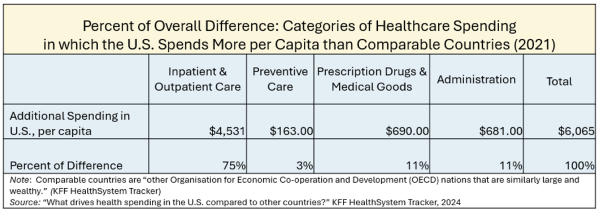
To drive the point home, a pie chart of the same:

The above data came from What drives health spending in the U.S. compared to other countries? (KFF HealthSystem Tracker). I’ll close with an excerpt from the article:
“The largest category of health spending in both the U.S. and comparable countries is spending on inpatient and outpatient care, which includes payments to hospitals, clinics, and physicians for services and fees such as primary care or specialist visits, surgical care, provider-administered medications, and facility fees.”
Reference:
What drives health spending in the U.S. compared to other countries? By Emma Wager Twitter, Shameek Rakshit, and Cynthia Cox / KFF HealthSystem Tracker August 2, 2024