The Basics:
Wealth is the sum of all tangible and intangible assets, minus liabilities and debt. Assets are specific items of value one owns that can be converted into a measurable medium of exchange, which I’ll just call “cash”. You need to convert assets into cash to pay taxes. Uncle Sam doesn’t accept yachts in lieu of cold, hard cash (speaking metaphorically of course; checks and electronic transfers are always welcome).
Liquid assets are cash or “cash-equivalents” - items easily converted into cash without significant loss of value, such as bank accounts, stocks, and money market funds. Illiquid assets are investments or properties that cannot be quickly converted into cash without a significant loss in value or a lengthy, complex selling process. Examples include real estate, private equity, venture capital, collectible art, and certain lock-up period investments. Selling Illiquid assets quickly is hard because these assets rarely have a ready pool of buyers and would likely require slashing prices, leading to substantial financial loss.
Billionaire Asset Allocation:
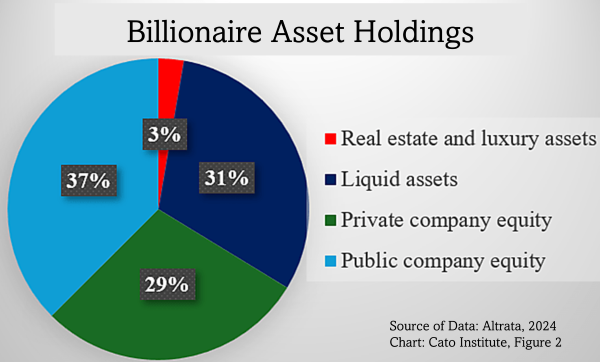
Explanation of Terms:
Real estate and luxury assets are tangible, "hard" assets often used by investors for portfolio diversification, inflation hedging, and wealth preservation. Examples of Real Estate Assets include single-family homes, apartments, office buildings, hotels, farmland, and Real Estate Investment Trusts (REITs), which allow for indirect, public investment in property. Examples of Luxury Assets include fine art, antiques, Rolex watches, jewelry, yachts, aircraft, collectibles and precious metals.
Real estate is considered an illiquid asset because it cannot be quickly converted into cash without a significant loss in value. Selling property typically takes weeks or months—involving inspections, appraisals, and financing approvals—making it hard to access funds quickly. Luxury goods are generally considered illiquid assets. While they often hold or appreciate in value, they cannot be quickly and easily converted into cash without a significant, potentially large, loss in value.
Liquid assets are cash or items easily converted to cash, typically within a few business days, without losing value. Income is considered a liquid asset immediately upon receipt when it is in the form of cash, deposited into a checking/savings account, or, in some contexts,, expected to be received within 20-30 days. It must be readily accessible without significant loss in value or penalties to be classified as liquid. Examples of liquid income/assets include cash, direct deposits, money market accounts, and “unrestricted” stocks or bonds (see below for explanation).
Public company equity represents ownership in a firm traded on public exchanges (NYSE, Nasdaq). Key examples include common stock, preferred stock (with shares that usually pay fixed dividends) and employee stock options in large, publicly listed companies like Apple, Microsoft, and Amazon. While public company equity is considered highly liquid in general, some stocks are illiquid assets, because they cannot be quickly sold or converted to cash at or near their fair market value without a significant price discount. This occurs with restricted securities, which are stocks or bonds that are restricted by law or contract. Restricted securities are typically held by company insiders. Billionaires tend to be company insiders, with their wealth concentrated in one or a few companies. Most U.S. billionaires derived their wealth from the companies they manage as executive owners or active shareholders, which means they hold large, often restricted, equity stakes in those companies.
Private company equity represents ownership in companies not listed on public exchanges. Most large private companies have multiple owners, often including founders, families, employees, and institutional investors like venture capital firms. Private company equity is usually illiquid because it lacks a public trading exchange, making it difficult to find buyers, and is often locked up for years during company growth. Unlike public stocks, private equity lacks transparent, frequent valuations, suffers from high transaction costs, and generally requires a long-term, multiyear capital commitment.
Answer and Question:
So where would billionaires get the cash to pay a wealth tax? Mostly from their liquid assets. A more important question for me is how a billionaire wealth tax would impact the economy and other Americans. And that will be my exploration for the month.
—
Chart Links:
Cato Institute: https://www.cato.org/blog/billionaires#:~:text=Ownership%20of%20business%20equity%20accounts,automobile%20collections%20within%20luxury%20assets.