Note: I’m taking a semi-break for a couple weeks and will be posting snippets and summaries of content from other sites, along with my own two-bits worth.
The World Happiness Report (WHR) is an annual publication that contains articles and rankings of national happiness, based on respondent ratings of their own lives. Its happiness ranking is based on a single “life evaluation” question called the Cantril Ladder:
Please imagine a ladder with steps numbered from 0 at the bottom to 10 at the top. The top of the ladder represents the best possible life for you and the bottom of the ladder represents the worst possible life for you. On which step of the ladder would you say you personally feel you stand at this time?
WHR rank countries using life evaluations rather than emotions, because they capture the quality of life in a more complete and stable way than emotional reports based on daily experiences. The number of people and countries surveyed varies year to year but, in general, more than 100,000 people in 140 countries and territories participate each year. Using Gallup World Poll data from 2005 onwards, WHR has identified six variables that account for more than three-quarters of the variation in life evaluation scores:.
Having someone to count on
Log GDP per capita
Healthy life expectancy
Freedom to make life choices
Generosity
Freedom from corruption
Here are some country rankings and scores from the 2026 report (my chart):
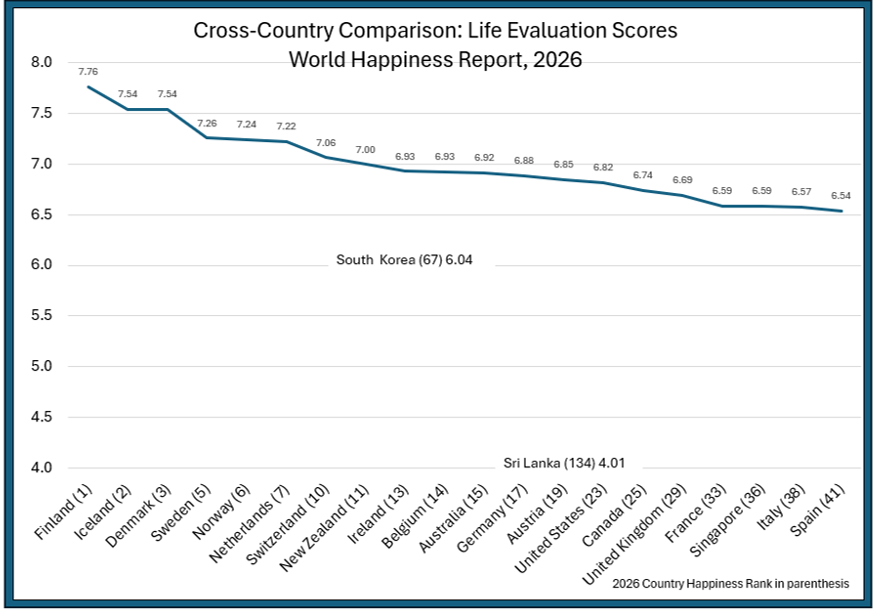
What I see here is that happiness levels are pretty high in developed countries, with their scores mostly bunched together in the 6-7 zone. Yet where I see “not bad”, other commentators see a big problem. For example, in Global Happiness and Wellbeing Policy Report 2019, a policy-focused companion to that year’s World Happiness Report, Jeffrey Sachs writes:
“The main economic strategy since Adam Smith’s Wealth of Nations has been to raise national wealth in order to raise national happiness. In one sense, the pursuit of economic growth has worked. The world today is now very wealthy, at least on average…Yet there is more at play. Many rich countries, including my own, the United States, have become a lot richer in recent decades, but not much happier or even less happy, according to survey data…The unregulated pursuit of economic growth is also unleashing new forms of unhappiness…”
Alarm bells! I see a political agenda that uses happiness data to exaggerate societal problems and promote specific policies. World Happiness Report 2023 was quite transparent about it:
"Once happiness is accepted as the goal of government, this has other profound effects on institutional practices.”
I also don’t think governments should strive for the ever-increasing happiness of their citizens. Focus on the basics, like healthcare, housing, opportunity, environmental protection, freedom, safety, economic growth, and good governance, and the people will be happy enough.
Sources: