Recap:
Among economists, economic freedom is generally understood as the freedom of individuals to work, do business, and enter into voluntary contracts with minimal government interference. Those who favor economic freedom emphasize individual liberty, private property, and competitive markets as drivers of human flourishing and economic prosperity. As the Heritage Foundation puts it: “At its heart, economic freedom is about individual autonomy: the freedom of choice that individuals enjoy in acquiring and using economic goods and resources. The underlying assumption…is that individuals know their own needs and desires best and that a self-directed life, guided by one’s own philosophies and priorities rather than those of a government or technocratic elite, is the foundation of a fulfilling existence—the “good life.”
Of course, plenty of economists, political scientists, psychologists, and just plain people are less enamored of free markets, economic freedom and small government. I have quibbles myself. For one thing, I’d like to see universal healthcare and stronger environmental protection in this country and I don’t see that happening without serious government intervention. But I do think the economic freedom lovers have a point: economic freedom is generally a good thing. Across multiple studies, it has been associated with life satisfaction, GDP growth, less government corruption, higher living standards, and rule of law.
The Heritage Foundation’s 2026 Index of Economic Freedom ranks 276 countries on the basis of overall economic freedom and various aspects of economic freedom, which are grouped into four pillars: rule of law, government size, regulatory efficiency and market openness. My goal in these posts is to explore possible correlates of economic freedom in 11 countries, as measured and ranked in this year’s Index.
This post will look at the relationship between economic freedom and worker well-being. For the latter I’ll be using survey data from Gallup’s State of the Global Workplace: 2026 Report, in which Gallup classifies employees into three wellbeing categories:
Thriving: Employees with positive views of their present life and the next five years
Struggling: Employees who manage day to day but express concern about the future
Suffering: Employees who report that their lives are going poorly and are likely experiencing significant challenges
Gallup’s survey is typically administered annually face to face or by telephone, covering more than 160 countries and areas since its inception. Scores are based on a 0-10 Cantril Scale, worst possible life to best.
Here are the percents of the working population who are thriving in my eleven countries, per Gallup and presented in order of their overall rank in the Economic freedom Index:
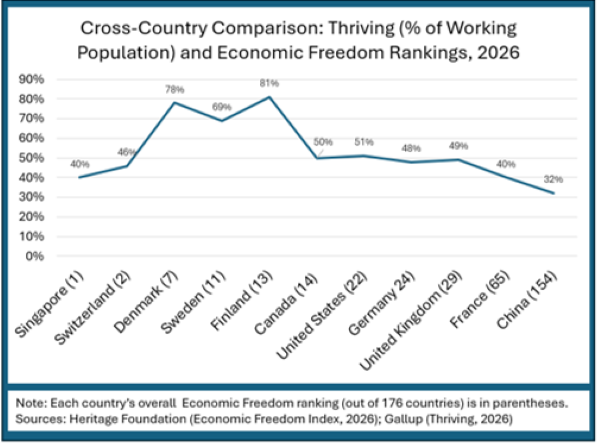
it’s hard to see a pattern here, except that the Nordics seem to be in a class by themselves, once again. What’s their secret sauce? I’m guessing competent governance, universal healthcare, generous social safety net, and a high level of economic freedom.