Recap:
Pew Research has just come out with a new typology that sorts the American public into nine groups based on their political values and beliefs. This is their ninth political typology study since the first one in 1987. The current typology is based on a survey of 10,357 U.S. adults conducted in November 2025. The 2026 Pew report includes additional data on the same respondents from 15 separate surveys conducted over the course of 2025 and 2026, as well as records from prior Pew Research election surveys and commercial voter files. Throughout this series, I’ll be delving into the data, looking for patterns and seeking a deeper understanding of what the hell in going on in this country.
Here are the nine types:
No Apologies Right: Unwavering Trump supporters with a pugilistic political style and an ‘America first’ outlook - 9% of U.S. adults and 19% of the Republican Party.
Faith First Conservatives: Staunch conservatives and strong Trump supporters who stand out for their faith-oriented politics - 12% U.S. adults and 25% of the Republican Party.
Unconventional Right: Conservative on immigration and culture, but they break from those to their right on some other key issues - 12% of U.S. adults and 19% of the Republican Party.
Pragmatic and Polite Right: Moderate in tone and on many issues, with a small-government streak - 11% of U.S. adults and 14% of the Republican Party.
Order and Opportunity Left: Economically liberal positions with moderate stances on immigration and concerns about safety and crime - 18% U.S. adults and 24% of the Democratic Party.
Left-Out Left: Democratic-leaning, with a mix of liberal and moderate views and limited confidence in the parties and the political system - 12% U.S. adults and 18% of the Democratic Party.
Loyal Liberals: Liberal across most issues, they are invested in the Democratic Party and in domestic and international institutions - 11% of U.S. adults and 21% of the Democratic Party.
Leftward Progressive: Liberal across the board, they are among the strongest critics of the U.S. economic system and the Trump administration - 7% of U.S. adults and 14% of the Democratic Party.
Tuned-Out Middle: Largely disconnected from politics, they tilt liberal on economic concerns but not on social issues - 9% of U.S. adults, 8% of the Republican Party, and 9% of the Democratic Party.
Note: Pew’s typologies reveal patterns and opinion clusters in complex data. They are not universal essences or timeless categories that discount individual variation or change. To be a political type is to have views and opinions that are closer to one data cluster than the others.
Source: Beyond Red vs. Blue: The Political Typology / Pew Research Center, Washington, D.C. June 10, 2026. Supplementary material: Appendix A, Appendix B, and Appendix C.
My last post addressed how much confidence Americans have that scientists act in the public interest. Most of the Pew panelists had a great deal or a fair amount of confidence in scientists, from 52% of the No Apologies Right to 99% of Leftward Progressives. I didn’t like Pew’s question, though: too vague and too broad. What does it even mean to act in the public interest? Is it a matter of intentions, self-belief, behavior or impact? All scientists, most scientists, all the time, some of the time, most of the time?
This post looks at our attitudes about American history. In public discussions, should we focus on the good stuff, bad stuff or both? I was surprised by the breakdown of survey responses. First, public discussions of our country’s failures:
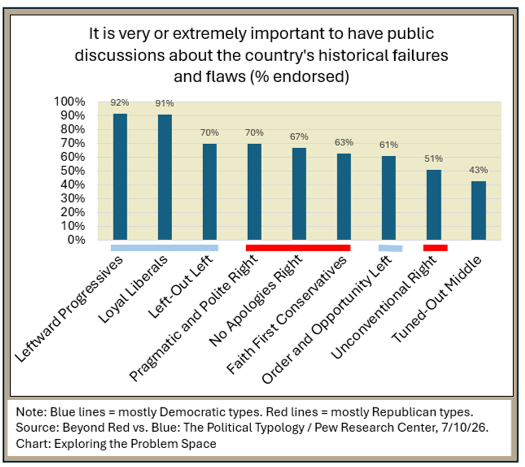
The Left and Right appear to agree: it’s important to discuss this country’s failures and flaws. This is not the impression I’ve gotten from the media or in conversations. These are mostly opinions voiced on the left that Republicans and Trump supporters only want to hear about the good stuff. Fact check: false!
Who wants to hear about the good stuff? Once again, there is considerable agreement across the partisan divide:
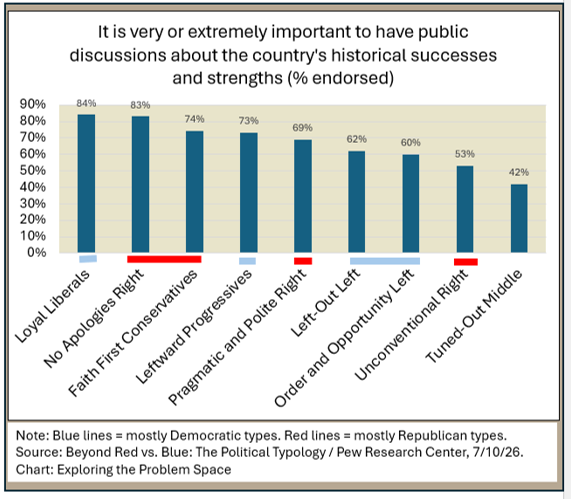
That’s it for this month - vacation time!