AI-induced job losses are coming soon and US workers are unprepared for the new reality. The Economist elaborates:
Policymakers should widen the ways in which people can keep learning after they leave school. In English-speaking countries, in particular, options other than university are too rare…Education should provide everyone with an opportunity. It must never become a blocker, sprinkling its benefits on a smarmy few while holding the less fortunate in their place.
-- University-for-all harms poor students the most, The Economist / June 25, 2026
Within a few years, artificial intelligence will displace a significant portion of the world’s highly paid knowledge workers… [Policymakers will struggle] to manage the reordering of society that will result from the mass displacement of highly productive labour.
— If you thought the global financial crisis was bad… by Carson Block, The Economist / June 25, 2026
If AI erodes entry-level white-collar jobs, America will need more routes into work that do not run through a four-year degree…. The main problem is that, for many in exposed jobs, no one yet knows what they should be trained for. Ideally roles should build on existing skills and preserve some professional identity.
— Can America retrain workers before AI leaves them behind? The Economist / August 2, 2026
So, yes, U.S. policymakers need to widen the ways in which Americans keep learning throughout their working lives. Unfortunately, meeting the retraining challenge of a post-AI world will cost a lot of money and the federal government is (effectively) broke.* That means we’ll have to tax our way to get there - but not so much as undermine the country’s economic vitality.
Which brings me to the Adult Student Basic Income (ASBI), a much-tweaked Grand Proposal I’ve been writing about for years, eg here, here, here, here, here, here and, most recently, here. And now for my latest iteration.
This ASBI would target Americans 25-54 who want to update their skills to match ever-changing employer demand. My current version would pay them $1000 a month, no more than $9,000 a year, up to $18,000 total over the age of eligibility, provided they are enrolled students in good standing at approved postsecondary training and education programs, from ESL classes to apprenticeships to on-the-job training to graduate school. The ASBI would not be means-tested, so recipients could work without jeopardizing payments, as long as they met school participation and performance requirements.
The ASBI would:
Increase labor market participation and productivity
Be politically feasible, given the modest cost and clear benefit to individuals, families, communities, and country.
Be accepted by employers, who would benefit from an increasingly capable workforce.
Limit fraud by imposing strict school and participation requirements, with compliance closely monitored.
Cap annual enrollment to around eight million beneficiaries a year, to stay within budget.
The ASBI would not:
Add to the national debt
Rely on unstable revenue sources, such as income or wealth taxes
Be based on unrealistic scenarios of societal change (e.g., robots or AI replacing most human workers, the rich footing the bill, capitalism gone or much minimized)
Disadvantage low-income recipients of other government benefits, because payments would not be included in other programs’ means-testing calculations.
Encourage long-term dependency, because recipients are no longer eligible to receive the benefit after the $18,000 has been paid out.
Requirements
American citizens between 25-54
Approved institutions and programs only
Minimum 10 hours a week participation, including time allotted for homework
Minimum two months participation at a time
Periodic performance confirmation
Acceptable education and training
A registry would be compiled from existing federal, regional and state agencies that oversee and accredit or approve postsecondary institutions and programs. As noted before, ASBI beneficiaries would have to participate in their program at least 10 hours a week, including time allotted for homework, as verified by training and education providers. For instance, a standard 3-unit college course generally requires about 6-9 hours of study time, so a 3-unit college class would be enough to qualify. Education and training programs would include:
College Classes
Adult Education
ESL Classes
GED/HS Diploma Programs
Job Readiness Training
Vocational Training
Internet Classes
Modular Courses
On-The-Job Training
Apprenticeships
Performance requirements would vary according to the institution, class, or program. As a rule, one would be required to get a passing grade or certificate of participation confirming that at least 10 hours a week of class or training time had been satisfactorily completed during the period of review. Those not meeting performance requirements would have their ASBI suspended until they submitted documentation of having completed the required coursework or training.
Funding
The ASBI would pay for itself through a modest payroll and income tax increase. Here’s a possible funding scenario:
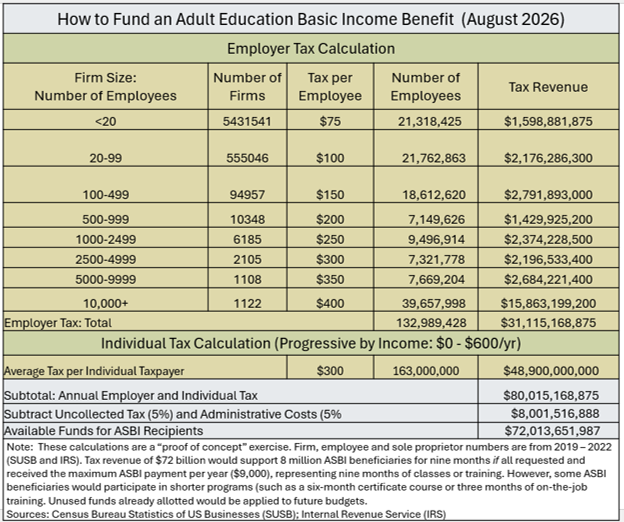
There are approximately 130 million Americans between 25-54, per the Federal Reserve: https://fred.stlouisfed.org/series/LNU00000060 (accessed 8/23/26).
Perks
As noted, the ASBI would not be means-tested, so recipients could work part- or full-time. Unlike Pell Grants, the ASBI would not drive up school fees because the amount of payment is not adjusted for the cost of attendance. Instead, the ASBI would turn students into cost-conscious consumers. It’s their money, so the less they pay for school, the more available for other expenses. The ASBI would also make students think twice before choosing an expensive private school when a cheaper but perfectly adequate public option is available. Plus, the ASBI would increase the psychological well-being of its recipients, partly by decreasing financial stress and partly by increasing personal agency: the sense of control and competence that comes from acquiring new skills and achieving goals by one’s own efforts.
—
* Specifically, the outstanding public debt reached $40,033,256,786,764 on August 20, 2026, up from $37 trillion in August 2025. This figure includes all federal debt - Treasury Bills, Notes, Bonds, and various other U.S. Treasury securities - “held by individuals, corporations, state or local governments, Federal Reserve Banks, foreign governments, and other entities outside the United States Government less Federal Financing Bank (FFB) securities” (fiscaldata.treasury.gov). The FFB is a government corporation, supervised by the Treasury Department, that centralizes and reduces the costs of federal and federally assisted borrowing. It does this by lending to federal agencies, purchasing their loan assets or obligations, and other funding mechanisms.
https://fiscaldata.treasury.gov/datasets/debt-to-the-penny/debt-to-the-penny