Recap from my last post:
According to a survey conducted by the Archbridge Institute earlier this year, most Americans say they have achieved or are on the way to achieving their own version of the American Dream. But around a third feel the Dream is out of reach. That’s almost double what Pew Research found in 2017, when just 17% of respondents considered the American Dream out of reach. The trend is obviously moving in the wrong direction. Why is this happening?
“Why” is a big question, one that can go meta quickly, with abstract talk of systemic this or that. I’d rather stay close to what the people themselves say about the barriers in their way of achieving the Dream. For example, here are the reasons given by respondents in the 2026 survey who said it was out of reach:
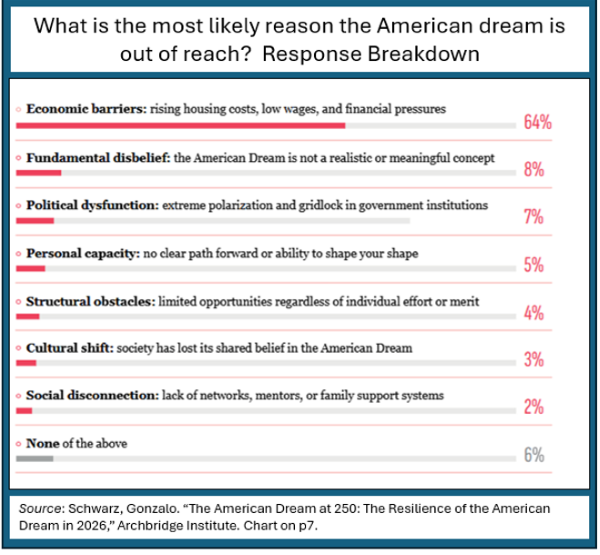
Ok, so a large majority cite housing, low wages and financial pressures as the main obstacles to achieving the American Dream, single-digit endorsement for all the other reasons.
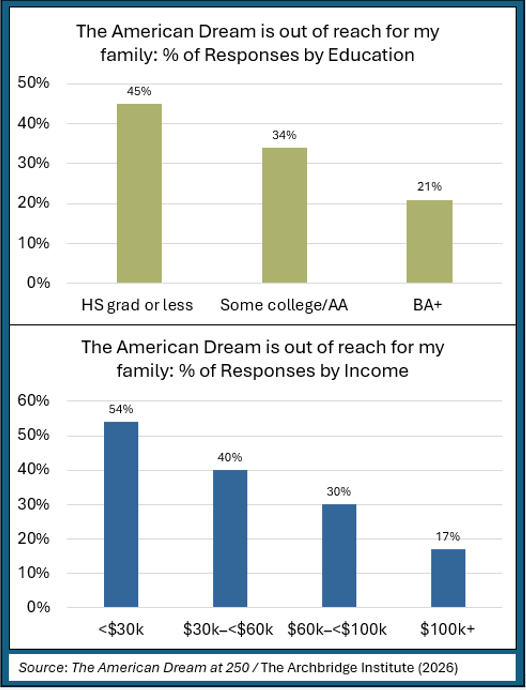
Who are these people? Unsurprisingly, they tend to have less education and income than the other survey respondents:
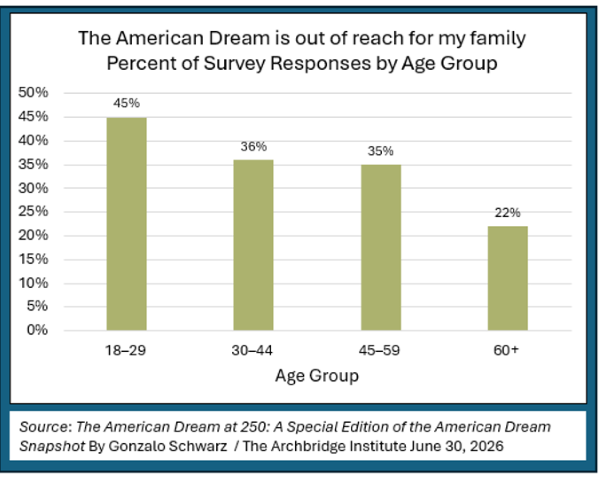
And a good chunk of them are young adults:
Next:: Why are the young so pessimistic?
Sources:
Current Population Survey (CPS ) Annual Social and Economic Supplement. The CPS is a joint effort between the Bureau of Labor Statistics and the Census Bureau. https://www.census.gov/data/tables/time-series/demo/income-poverty/cps-pinc/pinc-04.html
Most think the ‘American dream’ is within reach for them. Samantha Smith / Pew Research October 31, 2017. https://www.pewresearch.org/short-reads/2017/10/31/most-think-the-american-dream-is-within-reach-for-them/
The American Dream at 250: The Resilience of the American Dream in 2026. Gonzalo Schwarz, Gonzalo / Archbridge Institute June 2026 https://www.archbridgeinstitute.org/wp-content/uploads/2025/06/2026-American-Dream-Snapshot.pdf