Universal healthcare systems with mandatory insurance require all citizens and legal residents to have health coverage through government-run insurance programs, private insurers, or both. These systems are funded by taxes, premiums and out-of-pocket payments.
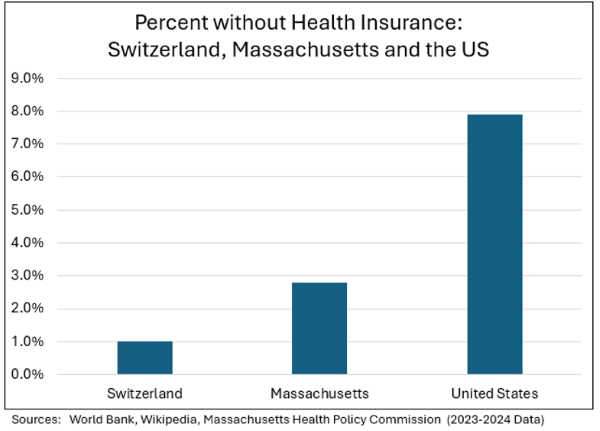
California, Massachusetts, New Jersey, Rhode Island, Vermont, and Washington, D.C., already have insurance mandates. Residents in these areas must have qualifying health coverage or face tax penalties. Except for New Jersey, their uninsured populations are lower than the U.S. rate of 7.9%. For instance, the uninsured rate is just 2.8% in Massachusetts and 3% in Washington D.C. That’s not too far from universal coverage.
It may be too much to expect every single American to be covered under an insurance mandate. At the very least, some residents will resist out of personal conviction. But getting down to 1% seems eminently doable. That’s what Switzerland has managed and if Switzerland can do it with a multi-payer system, why not the U.S.?
Now for some charts. First, the uninsured rates in Switzerland, Massachusetts, and the U.S.:
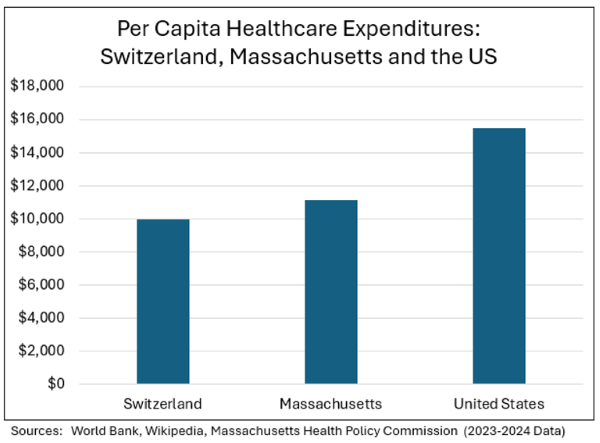
Now a comparison of health expenditures:
Now, per capita health expenditures as a percent of per capita GDP, an admittedly imperfect measure of healthcare affordability:
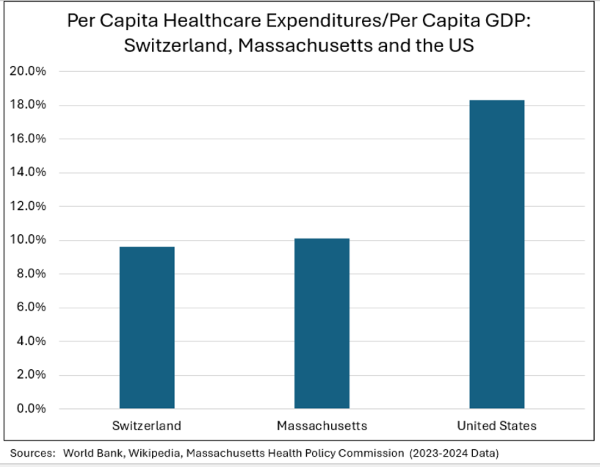
Ok, Massachusetts has achieved near-universal healthcare coverage at almost half the share of GDP as the U.S. has managed as a whole. How did they do it and what more can be done to achieve a truly universal healthcare system, which I’m defining as 99% coverage.
To be continued…
—
Note: Since posting this, I’ve learned the uninsured rate for Massachusetts is now 2.1%, according to the The 2025 Massachusetts Health Insurance Survey.
References:
HPC Calls for Recommitment to Health Care Cost Growth Benchmark and Urgent Action to Tame Growth / Massachusetts Health Policy Commission
List of U.S. states and territories by GDP / Wikipedia.
GDP per Capita by Country, in Current US$ / World Bank
The Uninsured Population and Health Coverage/ KFF