Recap:
Among economists, economic freedom is generally understood as the freedom of individuals to work, do business, and enter into voluntary contracts with minimal government interference. Those who favor economic freedom emphasize individual liberty, private property, and competitive markets as drivers of human flourishing and economic prosperity. As the Heritage Foundation puts it: “At its heart, economic freedom is about individual autonomy: the freedom of choice that individuals enjoy in acquiring and using economic goods and resources. The underlying assumption…is that individuals know their own needs and desires best and that a self-directed life, guided by one’s own philosophies and priorities rather than those of a government or technocratic elite, is the foundation of a fulfilling existence—the “good life.”
Of course, plenty of economists, political scientists, psychologists, and just plain people are less enamored of free markets, economic freedom and small government. I have quibbles myself. For one thing, I’d like to see universal healthcare and stronger environmental protection in this country and I don’t see that happening without serious government intervention. But I do think the economic freedom lovers have a point: economic freedom is generally a good thing. Across multiple studies, it has been associated with life satisfaction, GDP growth, less government corruption, higher living standards, and rule of law.
The Heritage Foundation’s 2026 Index of Economic Freedom ranks 276 countries on the basis of overall economic freedom and various aspects of economic freedom, which are grouped into four pillars: rule of law, government size, regulatory efficiency and market openness. My goal in these posts is to explore possible correlates of economic freedom in 11 countries, as measured and ranked in this year’s Index.
This post will address business freedom, an aspect of economic freedom pertaining to regulatory efficiency. Here’s what the Heritage Foundation has to say about business freedom:
Burdensome and redundant regulations are the most common barriers to the free conduct of entrepreneurial activity. By increasing the costs of production, regulations can make it difficult for entrepreneurs to succeed in the marketplace. Many regulations hinder business productivity and profitability, but regulations associated with the licensing of new businesses are often the ones that most inhibit entrepreneurship…Once a business is open, government regulation may interfere with the normal decision-making or price-setting process. Significantly, two countries with the same set of regulations can impose different regulatory burdens with different consequences. A country that applies its regulations evenly and transparently can lower the regulatory burden by facilitating long-term business planning, but a country that applies regulations inconsistently adds to the regulatory burden by creating an unpredictable business environment.
The World Bank used to conduct annual studies that ranked countries according to their “ease of doing business”. These studies investigated regulations that enhance and constrain business activity, covering their impact on 12 areas of the life of a business: starting a business, dealing with construction permits, getting electricity, registering property, getting credit, protecting minority investors, paying taxes, trading across borders, enforcing contracts, resolving insolvency, employing workers, and contracting with the government. Unfortunately, the World Bank discontinued this research program during the pandemic. Doing Business 2020 was its last report, which compared business regulations in 190 countries.
To my mind, “business freedom” and “ease of doing business” are pretty much the same idea. I expected country-level scores to reflect that, which is exactly what I found - at least for the eleven countries I’ve been comparing in this series. Check it out:
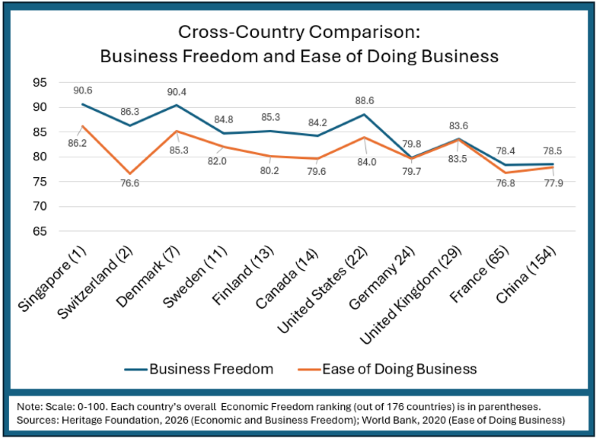
Once again, Denmark stands out: higher business freedom and ease of doing business than all the others, except Singapore. And this a country Bernie Sanders repeatedly called "socialist". More on why Bernie was so wrong: OECD / Economic Surveys: Denmark 2026, Econ Course:/ Employment security and labour market flexibility in Denmark, Danish Business Authority / Business in Denmark.