Recap: Among economists, economic freedom is generally understood as the freedom of individuals to work, do business, and enter into voluntary contracts with minimal government interference. Those who favor economic freedom emphasize individual liberty, private property, and competitive markets as drivers of human flourishing and economic prosperity. As the Heritage Foundation puts it: “At its heart, economic freedom is about individual autonomy: the freedom of choice that individuals enjoy in acquiring and using economic goods and resources. The underlying assumption…is that individuals know their own needs and desires best and that a self-directed life, guided by one’s own philosophies and priorities rather than those of a government or technocratic elite, is the foundation of a fulfilling existence—the “good life.”
Of course, plenty of economists, political scientists, psychologists, and just plain people are less enamored of free markets, economic freedom and small government. I have quibbles myself. For one thing, I’d like to see universal healthcare and stronger environmental protection in this country and I don’t see that happening without serious government intervention. But I do think the economic freedom lovers have a point: economic freedom is generally a good thing. Across multiple studies, it has been associated with life satisfaction, GDP growth, less government corruption, higher living standards, and rule of law.
The Heritage Foundation’s 2026 Index of Economic Freedom ranks 276 countries on the basis of overall economic freedom and various aspects of economic freedom, which are grouped into four pillars: rule of law, government size, regulatory efficiency and market openness. My goal in these posts is to explore possible correlates of economic freedom in 11 countries, as measured and ranked in this year’s Index.
This post will address fiscal health, an aspect of economic freedom pertaining to government size. Here’s what the Heritage Foundation has to say about the impact of fiscal health on economic freedom:
Public debt is an accumulation of government budget deficits over time. In theory, debt financing of public spending could contribute to productive investment and economic growth, or even be a mechanism for positive macroeconomic countercyclical interventions or even long-term growth policies. On the other hand, high levels of public debt can lead to higher interest rates, crowd out private investment, and limit government’s flexibility in responding to economic crises…Widening deficits and a growing debt burden, both of which are direct consequences of poor government budget management, erode a country’s overall fiscal health. Deviations from sound fiscal positions often limit economic freedom by disturbing macroeconomic stability and inducing economic uncertainty.
And here are the fiscal health scores for my eleven countries, presented in order of their overall rank in the Index:
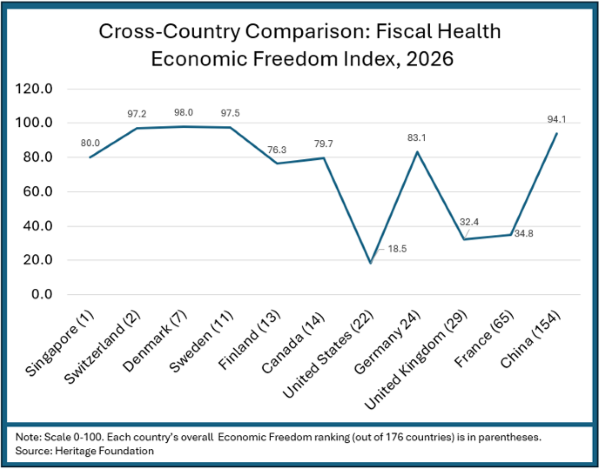
No surprise that the US, France and UK – the worst performers in the above chart - have super-high levels of public debt as a percent of GDP: 103%, 94%, and 101%, respectively, while top performers Switzerland, Denmark and Sweden have low levels of debt/GDP: 14%, 20%, and 34% (Central Government Debt, Percent of GDP, 2024 / International Monetary Fund).
What about Singapore’s debt? A whopping 177% of GDP—second highest after Japan among the advanced economies! Yet Singapore received a decent score on fiscal health in the Economic Freedom Index and has consistently maintained its top-tier AAA sovereign credit rating. Koon Hui Tee explains this paradox:
Singapore can afford its high gross public debt because it operates with a net asset position, borrowing not to fund day-to-day spending but to invest in financial markets and develop long-term infrastructure. Its government holds assets that well exceed its liabilities, generating investment returns that easily cover debt servicing costs… Unlike countries that borrow primarily to finance budget deficits or fund government spending, Singapore’s public debt is largely used to meet specific long-term objectives… Singapore’s fiscal credibility rests on an exceptionally strong institutional framework characterized by robust governance, long-term planning and a culture of fiscal prudence…At its core is the balanced budget rule over each term of government, which prevents the accumulation of fiscal deficits. - Much Ado About Nothing? Understanding Singapore’s High Gross Public Debt. Koon Hui Tee / AMRO April 7, 2026
Hmmm. A balanced budget rule, or at least a relatively-balanced budget rule…now there’s an idea worth considering.