Recap:
Barack Obama once declared economic inequality - that is, the large disparities in income and wealth between the rich and the rest - to be “the defining challenge of our time”. In a similar vein, Bernie Sanders called inequality “the great moral issue of our time”. Such sentiments are widespread on the left. Yet the issue of inequality in the U.S. doesn’t seem that big of a deal for lot of other Americans. According to recent polls, just half of us consider economic inequality a “very big problem” in the U.S. (YouGov and Pew). This doesn’t mean Americans of the non-left are a cold-hearted bunch. Most want a country with less poverty, greater social mobility and equal opportunity for all. But for many, the very idea of extreme inequality elicits little more than a shrug
As with the general public, so with economists: a good number consider inequality more a consequence than a cause of dysfunction in American society and not a huge problem in itself. But the arguments of economists seem to have little impact on public opinion (go figure!). And for many on the other side of the issue the problem of economic inequality goes way beyond its economic effects anyway. For them, the level of inequality in the U.S. also violates basic principles of fairness and leads to severe disparities in political power and wellbeing.
Does it?
I’m not going to attempt an answer to that question. Instead, I’m exploring pathways from the question to possible answers. Ever tiptoeing towards the light, carefully, with occasional missteps to be expected.
The last post in this series looked at various considerations that influence judgments of fairness, eg, need, merit, etc. This time I’ll focus on political power and how to tell if one group has too much of it. Reasoning that the politically powerful achieve their preferred political outcomes more often than the less powerful, I looked for evidence that this may be the case.
Which turned out to be an impossibly big project, so I limited my exploration to California and New York, states with the most billionaires in the U.S. This is what I found:
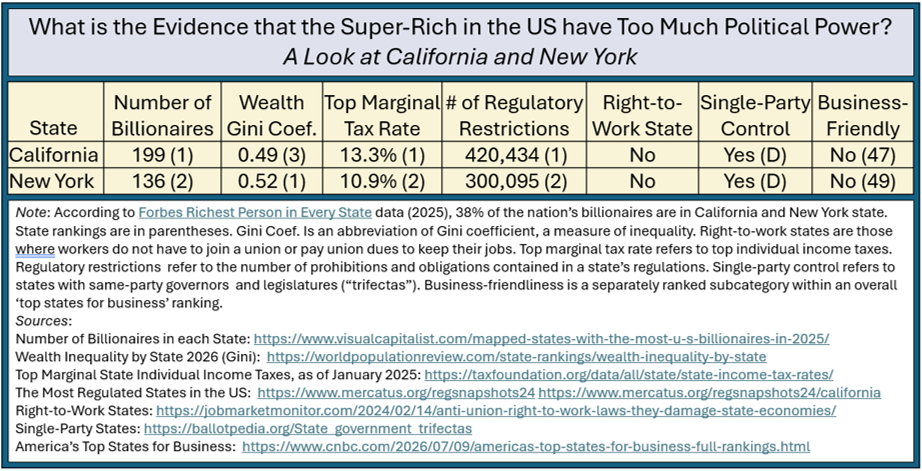
On the assumption that billionaires would prefer lower taxers, fewer regulations, weaker unions, more Republicans, and business-friendly policies in their states, I would say their political power is pretty limited in California and New York .
But is it still too much political power? How much is too much? What kind of evidence would prove the case one way or another? How do you operationalize and distinguish political power, influence, access, and input? When is such power, influence, etc pernicious and when is it beneficial?
To be tackled at a later date.
—
Note: The inspiration for this post was a July Economist article. Some bits and pieces:
“Billionaires, the thinking goes, use their market power and buy political influence to overcharge for everything from housing to groceries, and then pay low taxes on the profits…Yet many billionaires make their money without a hint that they enjoy questionable monopolies or political favour…
We call a billionaire’s wealth “uncompetitive” when it mainly comes from industries such as gambling, construction, defence and raw materials. These sectors often depend on political access. It is hard to open a mine or a casino, for instance, without friends in the government.
From 2001, [when our dataset of 7,000 billionaires begins], to 2014, the uncompetitive share of billionaire wealth rose slightly…Yet over the past decade the share derived from self-made entrepreneurs in competitive sectors has surged to an all-time high…And since 2021 the total wealth derived from uncompetitive sectors has declined.”
- The rise of the deserving rich. The Economist / July 23, 2026
Links:
Number of Billionaires in each State: https://www.visualcapitalist.com/mapped-states-with-the-most-u-s-billionaires-in-2025/
Wealth Inequality by State 2026 (Gini): https://worldpopulationreview.com/state-rankings/wealth-inequality-by-state
Top Marginal State Individual Income Taxes, as of January 2025: https://taxfoundation.org/data/all/state/state-income-tax-rates/
The Most Regulated States in the US: https://www.mercatus.org/regsnapshots24 https://www.mercatus.org/regsnapshots24/california
Right-to-Work States: https://jobmarketmonitor.com/2024/02/14/anti-union-right-to-work-laws-they-damage-state-economies/
Single-Party States: https://ballotpedia.org/State_government_trifectas
America’s Top States for Business: https://www.cnbc.com/2026/07/09/americas-top-states-for-business-full-rankings.html