Definitions of economic freedom vary among economists. For free market economists, economic freedom means the freedom of individuals to work, do business, and enter into voluntary contracts with one another with minimal government interference. These economists emphasize individual liberty, private property, and competitive markets as the drivers of economic prosperity and efficiency. The more libertarian-minded believe the government's role should be restricted to protecting property rights, enforcing contracts, defending the country against external threats, and maintaining law and order. Others accept a somewhat larger role for government to address such problems as market failures, monopolies, externalities, public goods, and poverty. However, free market economists generally agree that governments should avoid intervening in the market.
For its boosters, economic freedom is much more than a means to prosperity and efficient markets. It’s “the foundation of a fulfilling existence”. As the Heritage Foundation puts it:
At its heart, economic freedom is about individual autonomy: the freedom of choice that individuals enjoy in acquiring and using economic goods and resources. The underlying assumption of those who favor economic freedom is that individuals know their own needs and desires best and that a self-directed life, guided by one’s own philosophies and priorities rather than those of a government or technocratic elite, is the foundation of a fulfilling existence—the “good life.” Independence and self-respect flow from the ability and responsibility to take care of oneself and one’s family and are invaluable contributors to human dignity and equality.
Of course, plenty of economists, political scientists, psychologists, and just plain people are less enamored of free markets, economic freedom and small government. I have quibbles myself. For one thing, I’d like to see universal healthcare and stronger environmental protection in this country and I don’t see that happening without serious government intervention. But I do think the economic freedom lovers have a point: economic freedom is generally a good thing. Across multiple studies, it has been associated with life satisfaction, GDP growth, less government corruption, higher living standards, and rule of law.*
My goal in these posts is to explore possible correlates of country-level economic freedom, as measured by the Heritage Foundation’s annual Index of Economic Freedom. The Index ranks countries from "free" to "repressed" based on 12 aspects of economic freedom grouped into four broad pillars:
Rule of law (property rights, judicial effectiveness, and government integrity);
Government size (tax burden, government spending, and fiscal health);
Regulatory efficiency (business freedom, labor freedom, and monetary freedom); and
Market openness (trade freedom, investment freedom, and financial freedom).
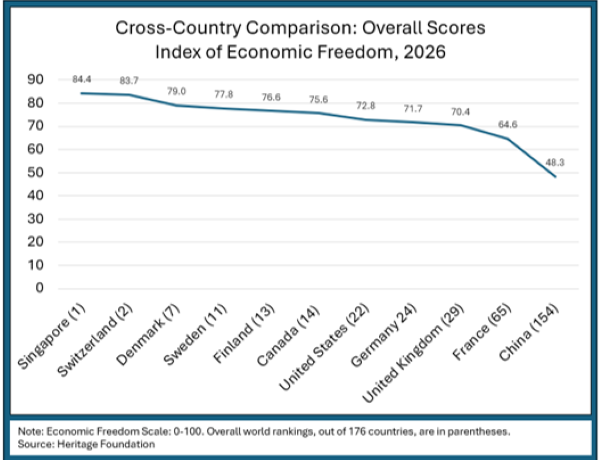
Each country is assigned an overall economic freedom score as well as separate scores for each factor. The 2026 Index covers 276 countries, of which I’ll focus on eleven: Singapore, Switzerland, Denmark, Sweden, Finland, Canada, United States, Germany, United Kingdom, France and Canada. Here are their overall scores and ranks:
Next: Cross-country comparison: overall economic freedom and tax burden
—
* In one review of 721 academic articles over 26 years, 33 papers associated economic freedom with “bad” outcomes, 323 papers with “mixed, null, or uncertain” outcomes, and 365 with “good” outcomes.