Recap: Among economists, economic freedom is generally understood as the freedom of individuals to work, do business, and enter into voluntary contracts with minimal government interference. Those who favor economic freedom emphasize individual liberty, private property, and competitive markets as drivers of human flourishing and economic prosperity. As the Heritage Foundation puts it:
At its heart, economic freedom is about individual autonomy: the freedom of choice that individuals enjoy in acquiring and using economic goods and resources. The underlying assumption…is that individuals know their own needs and desires best and that a self-directed life, guided by one’s own philosophies and priorities rather than those of a government or technocratic elite, is the foundation of a fulfilling existence—the “good life.”
Of course, plenty of economists, political scientists, psychologists, and just plain people are less enamored of free markets, economic freedom and small government. I have quibbles myself. But I do think the economic freedom lovers have a point: economic freedom is generally a good thing. Across multiple studies, it has been associated with life satisfaction, GDP growth, less government corruption, higher living standards, and rule of law.
The Heritage Foundation’s 2026 Index of Economic Freedom ranks 276 countries on the basis of overall economic freedom and various aspects of economic freedom, which are grouped into four pillars: rule of law, government size, regulatory efficiency and market openness. My goal in these posts is to explore possible correlates of economic freedom in 11 countries, as measured and ranked in this year’s Index.
This post will address tax burden, an aspect of economic freedom pertaining to government size. Here’s what the Heritage Foundation says about the impact of taxes on economic freedom:
All governments impose fiscal burdens on economic activity through taxation and borrowing. Governments that permit individuals and businesses to keep and manage a larger share of their income and wealth for their own benefit and their own use help to maximize economic freedom…Higher tax rates reduce the ability of individuals and firms to pursue their goals in the marketplace and thereby also reduce the overall level of private-sector activity…
The Index captures tax burden by measuring the overall burden from all forms of taxation as a percentage of total gross domestic product (GDP), including individual and corporate income, payroll, sales, and excise taxes, as well as tariffs and value-added taxes (VATs). Here are the tax burden scores for my eleven countries, presented in order of their overall rank in the Index:
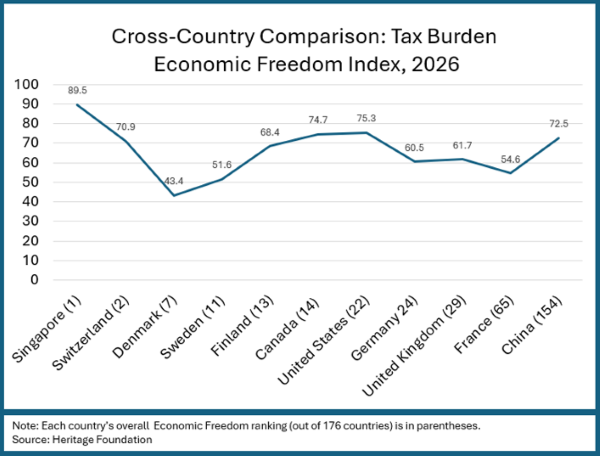
Note that the Nordics - Denmark, Sweden and Finland - rank much higher than the US on overall economic freedom, but they’re also high-tax countries. How do they do it? Long answer short: by balancing big government with sound fiscal management and business-friendly policies.