Recap: Among economists, economic freedom is generally understood as the freedom of individuals to work, do business, and enter into voluntary contracts with minimal government interference. Those who favor economic freedom emphasize individual liberty, private property, and competitive markets as drivers of human flourishing and economic prosperity. As the Heritage Foundation puts it:
At its heart, economic freedom is about individual autonomy: the freedom of choice that individuals enjoy in acquiring and using economic goods and resources. The underlying assumption…is that individuals know their own needs and desires best and that a self-directed life, guided by one’s own philosophies and priorities rather than those of a government or technocratic elite, is the foundation of a fulfilling existence—the “good life.”
Of course, plenty of economists, political scientists, psychologists, and just plain people are less enamored of free markets, economic freedom and small government. I have quibbles myself. But I do think the economic freedom lovers have a point: economic freedom is generally a good thing. Across multiple studies, it has been associated with life satisfaction, GDP growth, less government corruption, higher living standards, and rule of law.
The Heritage Foundation’s 2026 Index of Economic Freedom ranks 276 countries on the basis of overall economic freedom and various aspects of economic freedom, which are grouped into four pillars: rule of law, government size, regulatory efficiency and market openness. My goal in these posts is to explore possible correlates of economic freedom in 11 countries, as measured and ranked in this year’s Index.
This post will address government spending, an aspect of economic freedom pertaining to government size. The Index captures government spending by measuring the cost, size, and intrusiveness of government taken together. Here’s what the Heritage Foundation has to say about the impact of government spending on economic freedom:
While some government spending is beneficial, excessive spending can crowd out private economic activity, distort the market allocation of resources and lead to bureaucracy, lower productivity, inefficiency, and mounting public debt that imposes an even greater burden on future generations. All government spending, however, must eventually be financed by higher taxation and entails an opportunity cost—the value of the consumption or investment that would have occurred if the resources involved had been left in the private sector. Excessive government spending can easily crowd out private economic activity. Even if government spending helps to promote faster economic growth, such economic expansion tends to be only temporary, distorting the market allocation of resources and private investment incentives. Even worse, a government’s insulation from market discipline often leads to bureaucracy, lower productivity, inefficiency, and mounting public debt that imposes an even greater burden on future generations.
And here are the government spending scores for my eleven countries, presented in order of their overall rank in the Index:
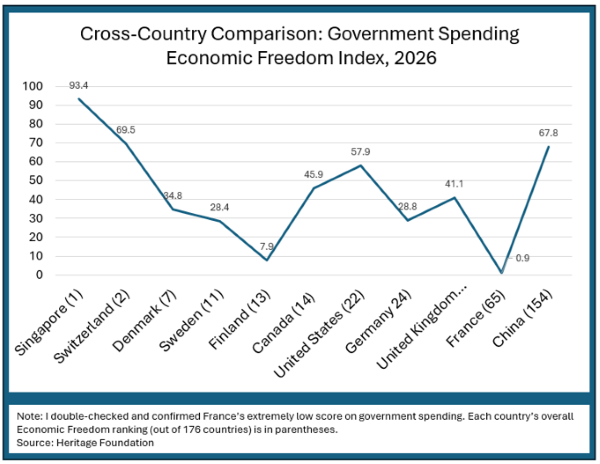
Reminder higher scores are better for economic freedom in this Index..
The surprise here is communist China: third best after Singapore and Switzerland*. How does Exhibit A of big, intrusive government manage to rein in spending? Something to explore at a later date.
Less surprising are all the big spenders, mostly European countries. I don’t see a clear pattern in the relationship between government spending and economic freedom rank, at least for these 11 countries.
—
* I double-checked and confirmed China’s score in the Index, but still have my doubts.