Recap:
Barack Obama once declared economic inequality - that is, the large disparities in income and wealth between the rich and the rest - to be “the defining challenge of our time”. In a similar vein, Bernie Sanders called inequality “the great moral issue of our time”. Such sentiments are widespread on the left. Yet the issue of inequality in the U.S. doesn’t seem that big of a deal for lot of other Americans. According to recent polls, just half of us consider economic inequality a “very big problem” in the U.S. (YouGov and Pew). This doesn’t mean Americans of the non-left are a cold-hearted bunch. Most want a country with less poverty, greater social mobility and equal opportunity for all. But for many, the very idea of extreme inequality elicits little more than a shrug.
As with the general public, so with economists: a good number consider inequality more consequence than cause of dysfunction in American society and less a big problem in itself. But for those who think otherwise, the problem of economic inequality goes way beyond its economic effects anyway. For them, the level of inequality in the U.S. violates basic principles of fairness and leads to severe disparities in political power and wellbeing.
Is that so?
I’m not going to attempt an answer to that question. Instead, I’m exploring pathways from the question to possible answers. Ever tiptoeing towards the light, carefully, with occasional missteps to be expected.
So far I’ve looked at different ways to assess fairness, political power and well-being (see here, here and here). My last post laid out evidence that social mobility increases wellbeing. But that doesn’t settle the matter, because there are different types of social mobility. For example,
“Relative mobility is about how the ranking of adults against their peers is (or is not) tied to the ranking of their parents against their peers. That is to say, ignoring dollar amounts, did adults who rank high or low in the income distribution also have parents who ranked high or low?” (Winship, 2014)
“Absolute mobility ignores rankings and simply considers whether adults tend to have higher, size-adjusted incomes than their parents did at the same age, after taking into account increases in the cost of living.” (Winship, 2014)
Intragenerational mobility tracks an individual’s changes in status, income and wealth over their lifetime. Moving up a career ladder is an example of upward intragenerational mobility. (Auerbach, 2019)
Intergenerational mobility examines status, income and wealth differences between parents and children across generations. A high-earning corporate executive who came from a low-income family is an example of upward intergenerational mobility. (Auerbach, 2019)
What type of social mobility impacts wellbeing the most? The type that boosts sense of purpose, hope, optimism, personal agency and the confidence that comes from mastery, progress and accomplishment. And that would be intragenerational mobility. Or as I prefer to call it, lifecourse mobility, especially from young adulthood onward. The research bears me out here: mobility over the lifecourse has stronger correlations to indicators of well-being than does intergenerational mobility (eg, Präg et al, 2022; Becker et al, 2025)
So is there much upward lifecourse mobility in America? Apparently, at least until a few years ago:
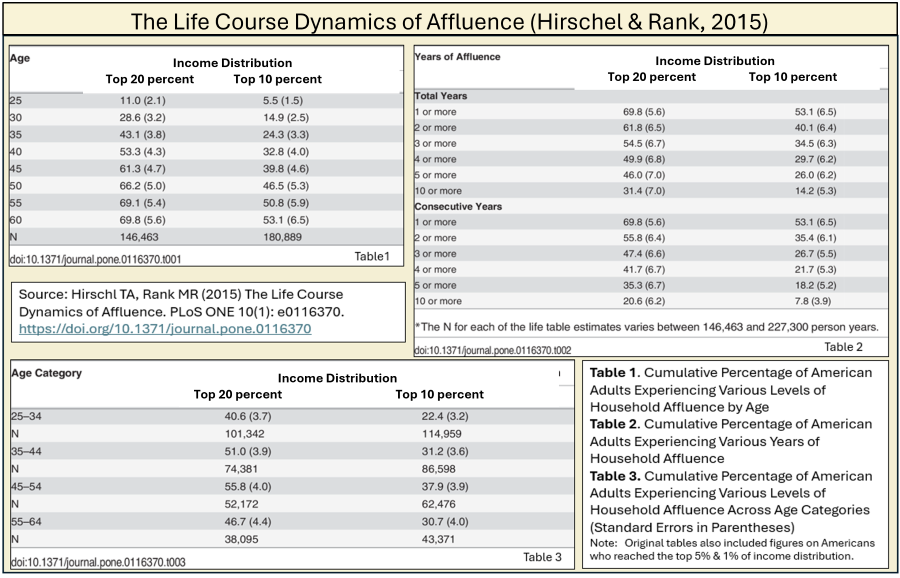
The authors drew upon 44 years of longitudinal information (1968-2011) on non-immigrant households and individuals in the U.S., which translates into several hundred thousand individual years of information embedded in the analysis.
Of course, what goes up often goes down. It’s still impressive that well into the 21st century around 70% of Americans had reached the top 20% income bracket at some point in their lives. That matters, because a few years of affluence can go a long way towards building a meaningful nest egg.
Now we need to update the research.
—
References
Testing the psychological costs of intergenerational social mobility: Evidence from a German panel study (2025) Becker, M. et al Social Science & Medicine 118522. https://doi.org/10.1016/j.socscimed.2025.118522
Income Inequality in America: Fact or Fiction, Chapter 6: Relative and Absolute Mobility Across Generations (2014) Scott Winship https://media4.manhattan-institute.org/wp-content/uploads/e21ib_1.pdf
Intragenerational Social Mobility and Well-being in Great Britain: A Biomarker Approach (2022) Patrick Präg, Nina-Sophie Fritsch, Lindsay Richards, Social Forces, Volume 101, Issue 2, 665–693, https://doi.org/10.1093/sf/soab153
Testing the psychological costs of intergenerational social mobility: Evidence from a German panel study (2025) Becker, M. et al Social Science & Medicine 118522. https://doi.org/10.1016/j.socscimed.2025.118522
The Life Course Dynamics of Affluence. (2015) Hirschl TA, Rank MR PLoS ONE 10(1): e0116370. https://doi.org/10.1371/journal.pone.0116370Types of Social Mobility (2019 Michael Auerbach / EBSCO Information Services) https://www.ebsco.com/research-starters/social-sciences-and-humanities/types-social-mobility EBSCO Information Services is a global provider of products and services primarily for libraries.